iLand Documentation Hub
Welcome to the central portal for navigating the iLand (individual-based forest landscape and disturbance model) documentation.
Part 1: Model Documentation
About iLand
iLand simulates forest ecosystems as complex adaptive systems. Its dynamics emerge from interactions between individual trees (the adaptive biotic agents) and their relationship with a spatially and temporally heterogeneous environment.
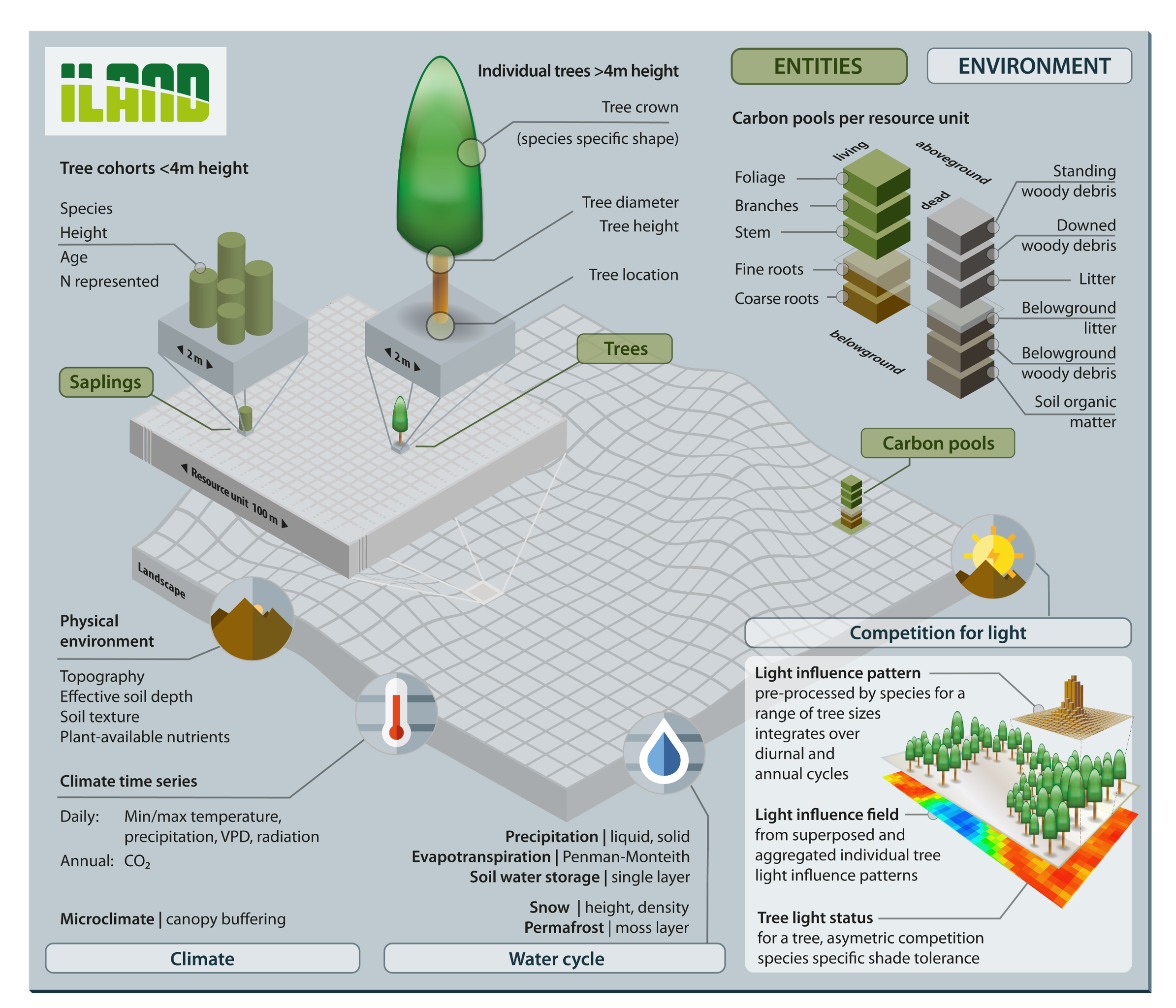
Physiological Processes
Continuous demographic and physiological processes driving resource acquisition, primary production, carbon/nitrogen allocation, water cycles, and decomposition.
Resource Availability & Competition | Light Competition | Light Influence Patterns (LIPs) | Belowground Competition
Primary Production (3-PG) | Carbon Allocation | Stem Growth | Environmental Modifiers | Phenology
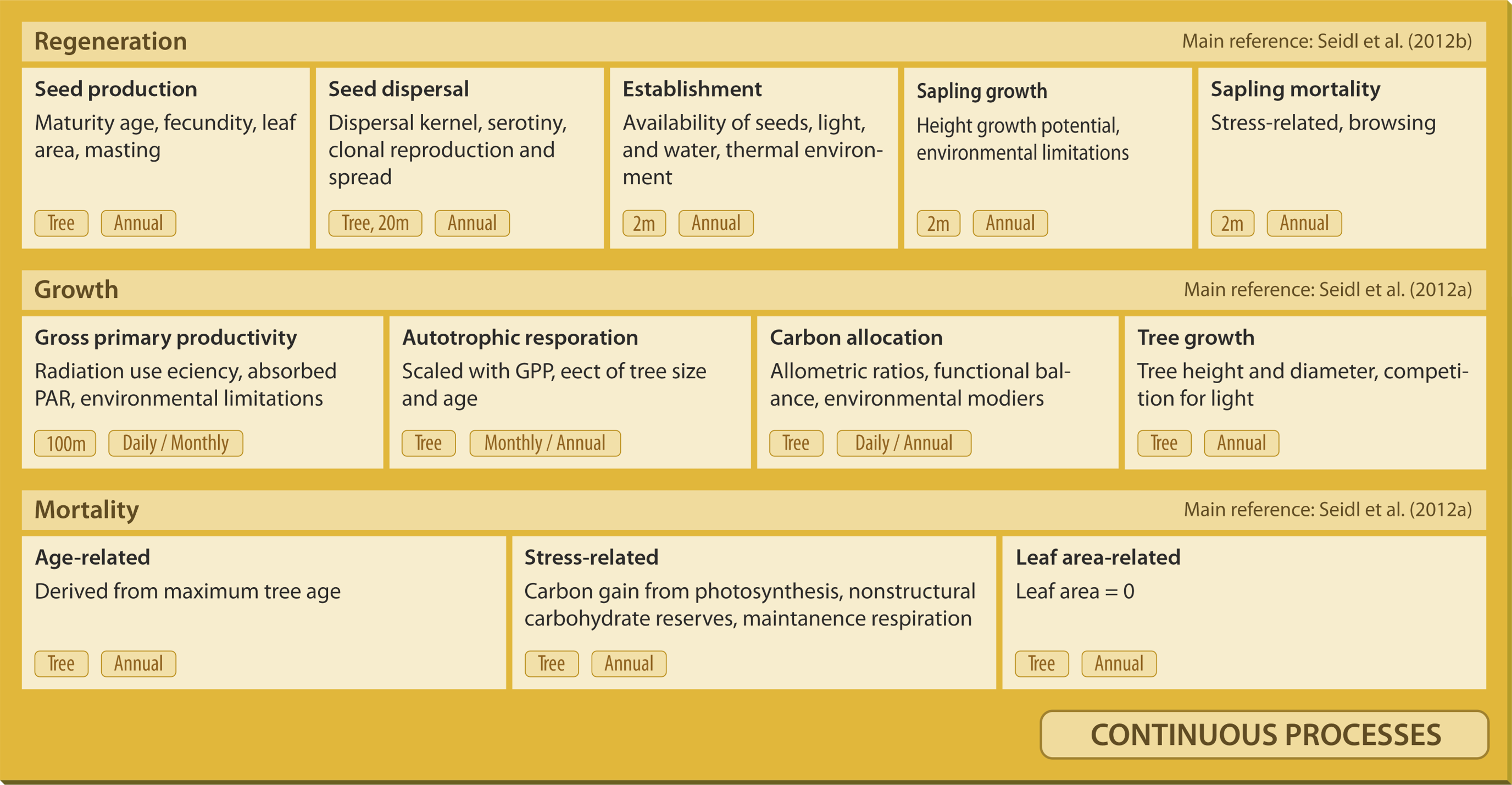
Demographic Processes
The continuous life-cycle stages of the forest: energy capture leads to individual tree growth, stress triggers tree mortality, and seeds disperse to establish regeneration.
Disturbances
Discontinuous, sudden ecological events that disrupt forest landscape dynamics. iLand explicitly simulates multiple natural disturbance agents.
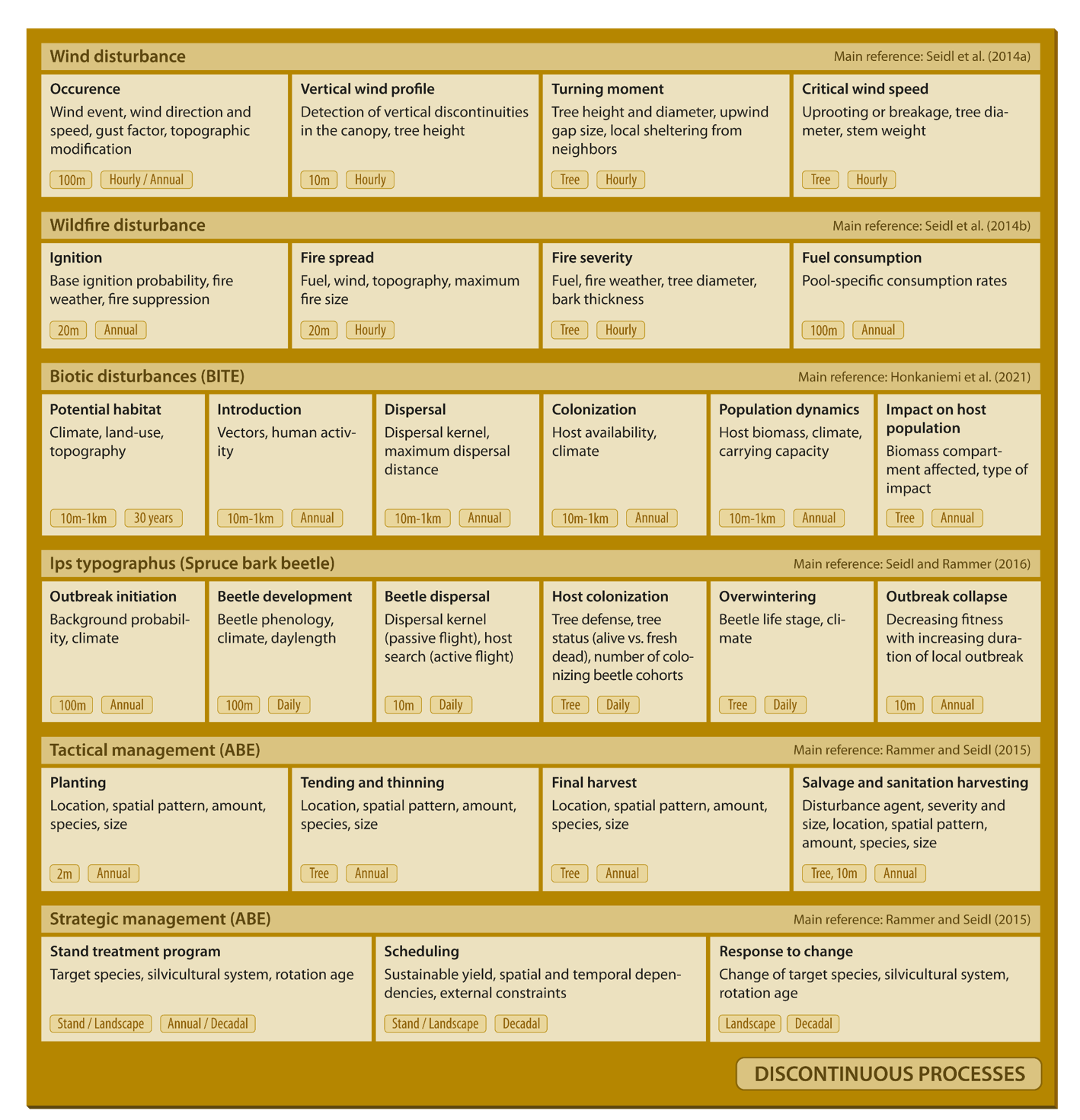
Forest Management
iLand models management interventions from simple harvesting and tree planting to complex multi-agent silvicultural regimes across ownership boundaries.
Submodules
Optional extensions covering localized geographical conditions, special vegetation tiers, or trophic interactions.
Part 2: Working with iLand
iLand Software
Executing simulations in GUI interactive mode or on headless high-performance computing clusters.
Landscape Setup
Configuring landscape extents, soil files, weather datasets, and vegetation parameters.
Scripting
Using scripting to orchestrate landscape-wide activities, write custom outputs, or extend core C++ code.
Part 3: Reference & Resources
API Documentation
Syntactical API details for iLand scripting interfaces.
Support & Publications
Connect with other iLand developers or browse model applications.